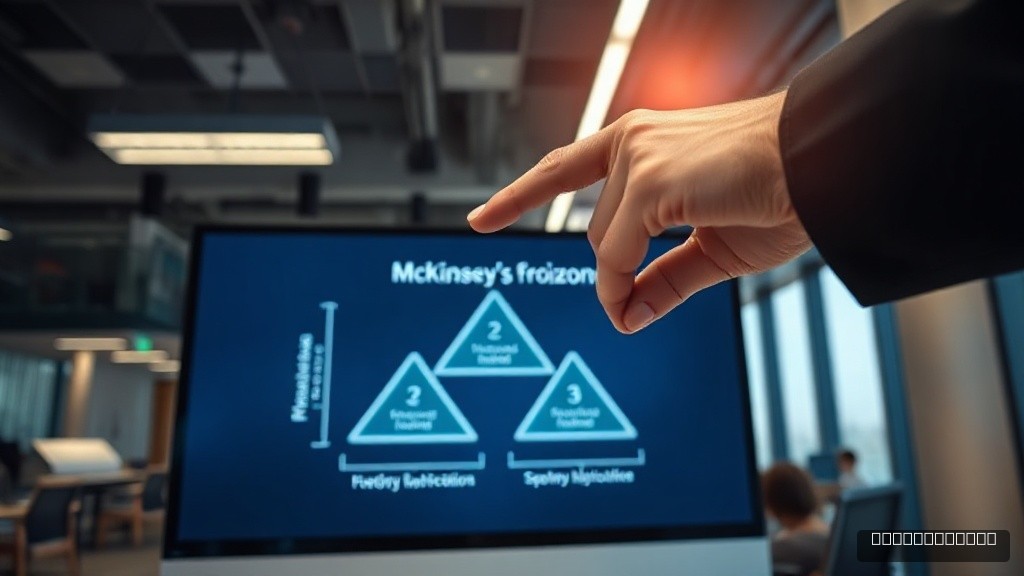
Mastering McKinsey’s 3 Horizons of Growth: A Modern Guide
Unlock the potential of McKinsey's 3 Horizons Framework to navigate current performance and future opportunities. Learn how to apply this model effectively.
·3 min read·278 views·Intermediate
What is McKinsey’s 3 Horizons Framework?
The McKinsey 3 Horizons Framework is a strategic model designed to help companies manage current performance while seeking future growth opportunities. Developed in the late 1990s, it categorizes business activities into three horizons: core business, emerging opportunities, and future options.
Why are the Three Horizons Important?
Understanding and managing the three horizons is crucial for businesses to sustain growth and innovation. Each horizon plays a unique role in balancing immediate needs with long-term visions, ensuring a company doesn't stagnate or lose its competitive edge.
Horizon 1: Extend and Defend the Core
Horizon 1 is about maintaining and expanding the core business. This includes optimizing operations, improving efficiency, and ensuring the business remains competitive in its current markets. Toyota exemplifies this by refining its manufacturing processes, which funds future ventures.
Horizon 2: Nurture Emerging Business
Horizon 2 focuses on scaling emerging business opportunities that have demonstrated potential. These require significant investment but can evolve into major profit centers. Amazon Web Services (AWS) is a classic example, having grown from a Horizon 2 project to a core component of Amazon’s success.
Horizon 3: Create Viable Options
This horizon is about exploring innovative ideas and technologies that could transform the future landscape. These initiatives are highly risky but essential for staying ahead of industry disruptions. Alphabet's 'X' projects, like Waymo, started as Horizon 3 experiments.
How Does the Modern Critique Affect the 3 Horizons?
Critics argue that the traditional sequence of the three horizons has become less relevant due to rapid technological advancements. Steve Blank suggests that disruptions now occur faster, compressing the time needed to move from Horizon 3 to Horizon 1.
Recommended Reading• Business
The Real Reason Companies Blame AI for Layoffs
Companies are pointing fingers at AI for mass layoffs, but the truth is far more infuriating. Discover why the AI excuse is just a cover for deeper issues.
Effective implementation requires balancing resources across all horizons. A common strategy follows the 70-20-10 rule: allocate 70% of resources to Horizon 1, 20% to Horizon 2, and 10% to Horizon 3. Each horizon demands different cultures and KPIs.
"In the long run, we are all dead." - John Maynard Keynes, reminding us that focusing only on the present can be short-sighted.
Key Takeaways
Manage each horizon concurrently rather than sequentially.
Allocate resources wisely, acknowledging each horizon's role.
Adapt the model to modern business speed, not just traditional timelines.
Frequently Asked Questions
How do the three horizons interact?
They interact by ensuring a balance between maintaining core operations and exploring new growth avenues, allowing businesses to innovate without neglecting immediate needs.
Can smaller businesses use this framework?
Yes, smaller businesses can adapt the 3 Horizons Framework by scaling its principles to their size and resource availability, focusing on sustainable growth and innovation.
What are the main challenges in implementing the model?
Challenges include balancing resources, maintaining focus on core operations, and fostering a culture that supports innovation across different horizons.
Is the 3 Horizons Model still relevant today?
While the model's timelines may need adjustment, its core principle of balancing present performance with future growth remains highly relevant.
Let's Collaborate
Ready to build something real?
I work with a small number of founding teams each quarter to launch products, mentor engineers, and integrate custom AI systems. Let's determine if we are a fit.
Direct & selective advisory • Limited slots available